DDoS Testing Services


A brief service interruption can impact customer trust, revenue, and brand reputation. One of the most serious cybersecurity threats businesses face today is a DDoS attack. DDoS attacks overwhelm networks, servers, applications, APIs, and security devices with malicious traffic, preventing legitimate users from accessing important services. Whether the target is a website, cloud application, customer portal, or internal platform, a successful DDoS incident can halt operations in minutes. StrongBox IT provides advanced testing services to help organizations evaluate their readiness against cyberattacks. Our approach simulates real-world attack scenarios in a controlled environment, measures the effectiveness of existing defenses, and identifies weaknesses before attackers exploit them. With our testing services, businesses gain actionable insights to improve availability, resilience, and incident response.
What is DDoS?
DDoS stands for Distributed Denial of Service. In a DDoS attack, attackers use large networks of compromised devices to send overwhelming traffic to a target. The goal of DDoS is to exhaust bandwidth, CPU, memory, connection tables, or application resources so that legitimate users cannot access services.
Modern campaigns are highly sophisticated. A single incident may combine multiple attack techniques, shift traffic patterns, and target several infrastructure layers simultaneously. Because attack tactics continue to evolve, regular testing is essential.
Why DDoS testing matters
DDoS testing helps organizations determine how well their infrastructure performs under attack conditions. Instead of waiting for a real incident, businesses can proactively assess resilience, validate mitigation controls, and strengthen response procedures.



Benefits of DDoS testing
Identifies vulnerabilities in networks and applications.
Measures response capacity.
Validates firewall, WAF, CDN, and anti-DDoS configurations.
Improves monitoring and alerting.
Reduces downtime caused by DDoS attacks.
Strengthens incident response.
Supports compliance and audit requirements.
Impacts of a DDoS attack on business
A DDoS attack can affect every aspect of an organization. Even a short outage may result in substantial losses.

Revenue loss
A DDoS incident can interrupt online sales, payment processing, and customer transactions. For businesses that depend on digital services, downtime translates directly into lost revenue.

Customer dissatisfaction
Repeated DDoS disruptions frustrate users and erode confidence. Customers expect uninterrupted access, and persistent issues may drive them to competitors.

Brand reputation damage
Publicly visible DDoS attacks can harm an organization's reputation. Clients and partners may question the effectiveness of existing security measures.

Operational disruption
DDoS attacks can affect employee productivity, internal systems, communication tools, and remote access services.
Revenue loss
A DDoS incident can interrupt online sales, payment processing, and customer transactions. For businesses that depend on digital services, downtime translates directly into lost revenue.
Customer dissatisfaction
Repeated DDoS disruptions frustrate users and erode confidence. Customers expect uninterrupted access, and persistent issues may drive them to competitors.


Types of DDoS attacks we simulate
Multiple attack categories are simulated to assess real-world resilience.
Volumetric DDoS attacks
These attacks consume bandwidth by flooding the target with massive traffic volumes.
Protocol DDoS attacks
These attacks exploit weaknesses in TCP/IP and network protocols to exhaust infrastructure resources.
Application-layer DDoS attacks
These attacks target web applications, APIs, and login pages using seemingly legitimate requests.
Multi-vector DDoS attacks
These attacks combine several methods simultaneously to bypass defenses.
DNS-based DDoS attacks
These attacks misuse DNS infrastructure to overwhelm networks and services.
Encrypted attacks
These attacks use SSL/TLS traffic to increase processing overhead and evade detection.
When Your Business Needs DDoS Testing
Any organization with an online presence can become a DDoS target. Testing is especially important if:
-
 Your business depends on continuous uptime.
 -
You process financial, healthcare, or personal data.
-
You have never performed DDoS testing.
-
You experienced unexplained outages.
-
You are migrating to the cloud.

-
You are launching new digital services
-
You are expanding globally.
-
You must meet compliance requirements.
-
You want to validate third-party protections.
-
You need executive assurance regarding readiness.
Industries that need DDoS testing services

Banking and Financial Services
DDoS attacks can disrupt payments, online banking, and trading platforms.

Healthcare
DDoS incidents can affect patient portals, telemedicine, and clinical systems.

E-Commerce
DDoS attacks can prevent customers from browsing and purchasing products.

SaaS Providers
DDoS disruptions can violate service-level agreements and affect customer trust.

Government
DDoS attacks can interrupt citizen services and public information portals.

Telecommunications
DDoS attacks can impact core infrastructure and subscriber services.

Manufacturing
DDoS incidents can affect connected systems and supply chain operations.

Education
DDoS attacks can disrupt learning platforms and examination portals.
Process of DDoS testing services
Our DDoS testing services are designed to be safe, controlled, and highly informative.
Initial assessment and planning
We identify critical systems and define testing objectives.
Attack simulation design
We build realistic DDoS scenarios based on current threat intelligence.
Execution of controlled DDoS attacks
We launch authorized DDoS traffic without affecting production stability.
Monitoring and analysis
We evaluate performance and detection effectiveness.
Detailed reporting and insights
We document findings, thresholds, and response gaps.
Mitigation strategy and support
We recommend technical and operational improvements for DDoS resilience.
Solution we offer via our DDoS testing services
Our DDoS Testing Services provide practical deliverables that help organizations understand weaknesses, strengthen defenses, and improve overall resilience against large-scale attacks.
DDoS testing services

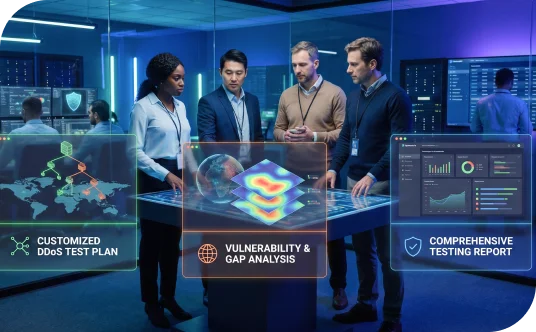
Key deliverables included in our services
Customized DDoS test plan aligned with your infrastructure and business objectives.
Detailed list of identified vulnerabilities and security gaps.
Comprehensive testing summary report with findings and recommendations.
Each engagement is designed to deliver clear, actionable insights. In addition to the core deliverables, we provide practical recommendations to improve configurations, optimize mitigation controls, and strengthen incident response procedures. Our comprehensive security support helps organizations build long-term resilience and maintain reliable service availability.
Why choose strongBox IT for DDoS testing services?
StrongBox IT combines technical expertise, proven methodologies, and industry experience to deliver effective DDoS Testing Services.

Certified security experts

Customized DDoS testing

Safe and controlled execution

Actionable reporting

End-to-End support

Industry experience
Why regular DDoS testing is important
DDoS threats change constantly. Infrastructure also evolves over time. Regular DDoS testing ensures your defenses remain effective after:


Conclusion

Conclusion
Business availability is essential, and DDoS attacks remain one of the most disruptive cyber threats. Proactive DDoS testing helps organizations identify weaknesses, validate defenses, and strengthen response capabilities before a real DDoS incident occurs.
StrongBox IT’s DDoS Testing Services provide controlled DDoS simulations, comprehensive reporting, and practical recommendations to improve resilience. Our experts help you build a stronger DDoS defense strategy that protects uptime, revenue, customer trust, and brand reputation.
Do not wait for a real DDoS attack to reveal your vulnerabilities. Contact StrongBox IT today to strengthen your organization with expert DDoS Testing Services.
Frequently Asked Questions (FAQ)
DDoS testing is a controlled exercise that simulates DDoS attacks to evaluate how networks, applications, and security controls perform under malicious traffic.
Several reputable companies offer DDoS testing services, including Cloudflare, Akamai, and NetScout The best choice depends on your network size, budget, compliance requirements, and the level of testing and mitigation support you need.
Businesses should run DDoS resilience tests at least annually and after major infrastructure, network, or application changes. Organizations with high-risk or mission-critical services may benefit from quarterly testing and continuous monitoring.
Yes, DDoS testing is safe when it is carefully planned, authorized, and conducted using controlled traffic levels and professional testing tools. To minimize risk, schedule tests during low-traffic periods and monitor systems closely throughout the exercise.
Get the Enterprise-Grade Protection Your Business Deserves with Comprehensive Cybersecurity Solutions.