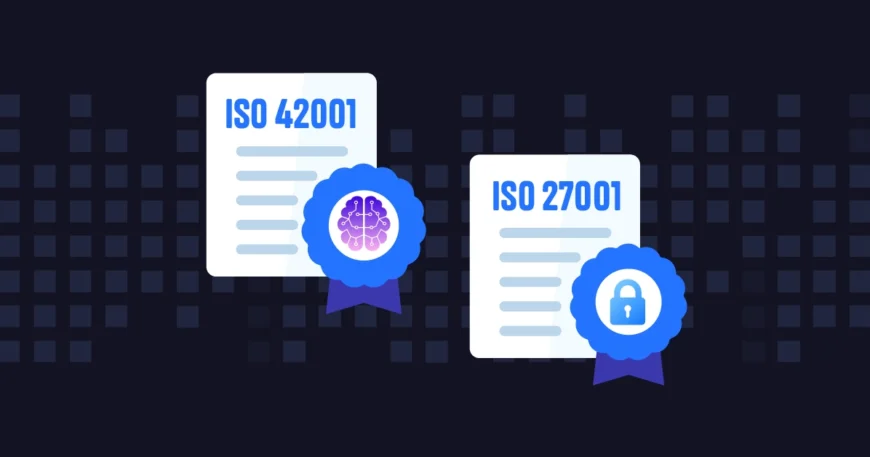
Organisations increasingly depend on secure information systems and intelligent technologies to support their operations. Two key ISO standards — ISO 27001 and ISO 42001 — address important areas of risk and governance, yet they serve distinct purposes. Understanding their differences, overlaps, and practical applications is essential for organisations seeking to strengthen information security and ensure the responsible use of artificial intelligence (AI).
In this article, we explain what ISO 27001 and ISO 42001 are, how they differ, when each compliance is applicable, where they intersect, and how organisations like Strongbox IT can help in choosing the right compliance strategy.
What is ISO 27001?
ISO/IEC 27001 is an internationally recognised standard for Information Security Management Systems (ISMS). It provides a systematic framework to identify, evaluate, and manage information security risks through policies, processes, and technical controls.
The primary goals of ISO 27001 are to:
Protect the confidentiality, integrity, and availability of information
Establish controls for secure data handling, access management, encryption, and incident response
Demonstrate compliance with internal and regulatory requirements
ISO 27001 certification proves that an organisation has robust processes to secure its information assets and respond effectively to security threats.
What is ISO 42001?
ISO/IEC 42001 is a newer standard focused on AI Management Systems (AIMS). While ISO 27001 secures data and systems, ISO 42001 is designed to govern the artificial intelligence lifecycle and usage, including ethical considerations such as transparency, accountability, bias mitigation, and responsible deployment.
ISO 42001 helps organisations ensure that AI technologies are:
Developed and deployed in a manner that is fair, safe, and explainable
Governed with accountability and ethical oversight
Aligned with legal and societal expectations
Compared with ISO 27001’s broad security focus, ISO 42001 extends into AI-specific governance, requiring documentation of model decisions, risk assessments tailored to AI systems, and controls that address unique AI risks.
ISO 42001 vs ISO 27001: key differences
Though both standards support governance and risk management, their focus areas and controls differ significantly:
ISO 27001’s controls are technical and process-oriented, protecting data from breaches and misuse. In contrast, ISO 42001 emphasises principle-driven and evaluative controls designed around AI behaviour and societal impact.
Where do ISO 42001 and ISO 27001 intersect?
Although ISO 27001 and ISO 42001 address different risk areas, they intersect at several points within modern organisations.
Both standards follow a risk-based management approach, requiring organisations to identify, assess, and mitigate risks systematically. ISO 27001 focuses on risks related to information security, while ISO 42001 extends this approach to risks arising from AI systems, such as bias, lack of transparency, or unintended outcomes.
Another key overlap is governance and accountability. Both standards emphasise clear roles, documented policies, continuous monitoring, and management oversight. When AI systems rely on sensitive or regulated data, ISO 27001 controls help secure that data, while ISO 42001 ensures the AI uses it responsibly.
There is also alignment in audit readiness and documentation. Evidence such as risk assessments, access controls, incident response processes, and monitoring mechanisms can support compliance across both standards when implemented cohesively.
From a practical standpoint, organisations that already operate an ISO 27001-certified ISMS often find it easier to extend their framework to include ISO 42001 controls. Strongbox IT commonly sees this integrated approach reduce duplication, improve governance clarity, and strengthen overall security and trust.
When should each ISO standard be used in the real-world?
Choosing between ISO 27001 and ISO 42001 depends on how your organisation operates and where its primary risks are concentrated.
ISO 27001 should be used when:
The organisation handles sensitive data such as customer information, financial records, or intellectual property
Regulatory compliance and data protection are key priorities
Cybersecurity risks, data breaches, and access control are major concerns
This standard is widely applicable across industries, regardless of whether AI is used.
ISO 42001 becomes relevant when:
The organisation develops, deploys, or relies on AI systems for decision-making or automation
AI outputs impact customers, employees, or business outcomes
Ethical use, transparency, explainability, and accountability of AI systems are required
In many real-world scenarios, both standards are necessary. For example, an organisation using AI to analyse customer data must secure that data under ISO 27001 while ensuring the AI system operates responsibly under ISO 42001.
Strongbox IT typically advises organisations to assess their data exposure, AI usage, and regulatory obligations together. This helps determine whether a single standard is sufficient or whether a combined approach delivers stronger governance and long-term resilience.
Integration and implementation considerations
Although these standards address different domains, they can be aligned and integrated:
Both rely on a risk-based approach and structured management systems
Documentation and audit readiness are essential in both cases
Implementing ISO 42001 alongside an existing ISO 27001 system can enhance governance, especially where AI models interact with sensitive data
However, integration requires careful planning. AI-specific risks — such as bias, explainability, and accountability — must be mapped against existing information security processes to avoid gaps and duplication.
How Strongbox IT can help
Managing compliance with ISO standards can be complex — especially when balancing traditional security requirements with AI governance needs.
Strongbox IT assists organisations in:
Evaluating whether ISO 27001, ISO 42001, or both are relevant based on business objectives
Designing and implementing integrated management systems
Preparing documentation and controls aligned with certification requirements
Conducting readiness assessments and internal audits
With Strongbox IT’s expertise, businesses can build robust security and governance frameworks that are future-ready and compliant with global standards.
Conclusion
In conclusion, ISO 27001 and ISO 42001 are complementary but distinct standards:
ISO 27001 focuses on securing information assets and protecting against threats
ISO 42001 concentrates on AI governance, accountability, and ethical use of AI technologies
Your choice depends on your organisation’s risk landscape and strategic priorities. For traditional information security, ISO 27001 is the foundational choice. For organisations using AI in mission-critical processes, ISO 42001 provides the framework for responsible AI governance. In many cases, implementing both standards together offers a comprehensive governance model that ensures both secure information and ethical use of AI systems — a combination that positions organisations for trust, compliance, and innovation in an evolving technological environment.