Latest Posts
Manual vs Automated Testing in IoT
October 22, 2026
The Internet of Things (IoT) connects devices such as smart security cameras, wearable monitors, industrial sensors, and fleet tracking systems to digital platforms. These devices rely on hardware, embedded software, network connections, and cloud applications to function as expected.
Testing an IoT system requires more than checking whether its features work correctly. Organisations must also understand how devices behave in different environments, respond to unexpected situations, and protect the information they handle. A device may pass routine checks but still experience problems when its network connection drops or its physical components are affected.
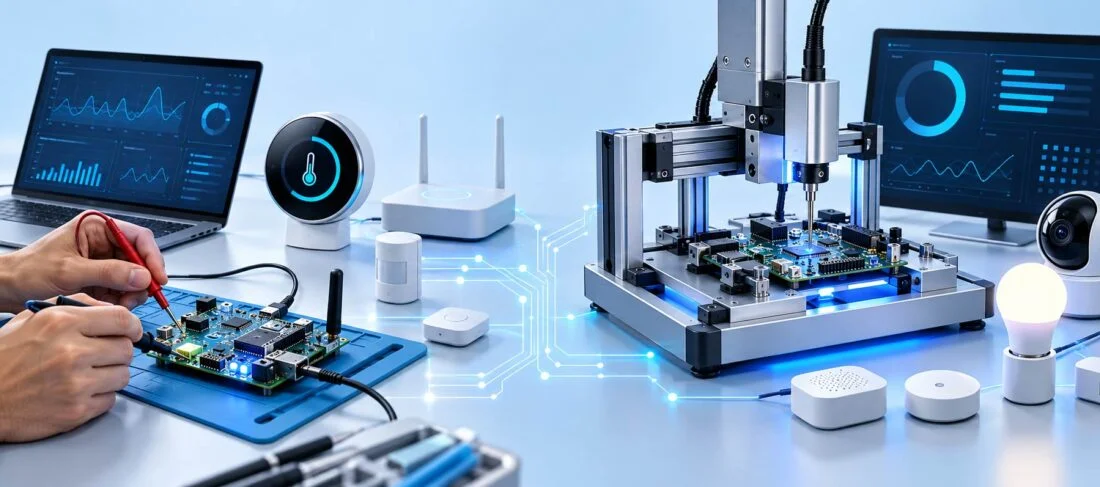
Manual testing helps IoT testers investigate unusual device behaviour and scenarios that automated scripts may miss, providing flexibility and deeper insights.
Understanding Manual and Automated IoT Testing
Manual testing involves examining a device or system through direct interaction, observation, and investigation. Automated testing uses tools and scripts to repeat predefined checks.
Both methods support IoT testing, but they have different strengths.
| Testing Factor | Manual IoT Testing | Automated IoT Testing |
|---|---|---|
| Main Focus | Physical behaviour, usability, unexpected conditions, and security investigation | Repetitive checks, regression testing, and performance validation |
| Flexibility | Allows testers to adapt their approach based on observations | Primarily follows predefined test instructions |
| Physical Assessment | Suitable for evaluating buttons, displays, sensors, and device handling | Can verify specific functions but cannot fully judge physical usability |
| Unexpected Behaviour | Helps investigate unusual device responses and environmental changes | Detects predefined conditions and can test unexpected inputs when programmed |
| Security Assessment | Supports hands-on investigation of device interfaces, firmware behaviour, and access controls | Supports repeatable scans and automated checks for known issues |
| Best Use Cases | Exploratory testing, usability, physical security, and complex scenarios | Repeated functional checks, large-scale test execution, and regression testing |
Why Manual Testing Is Important for IoT Systems
IoT devices interact with their surrounding environment, which introduces testing requirements that cannot always be covered by predefined scripts. Manual testing helps teams examine these interactions and understand how a device behaves beyond its expected operating conditions.
IoT products often contain physical controls, displays, sensors, and indicator lights. Their performance depends not only on software but also on how people interact with the device.
For example, when testing a smart security camera, a tester can check whether the controls are easy to use, the video feed remains clear under different lighting conditions, and the device responds correctly to changes in its settings.
These observations help identify usability and operational problems that a simple automated function check may not reveal.
Connected devices operate under changing conditions. Network interruptions, power fluctuations, environmental changes, or sensor errors can affect their behaviour.
Manual testing allows testers to explore these situations and observe how the device responds. For example, a tester can interrupt a smart sensor's network connection, restore connectivity, and examine whether the device reconnects correctly and handles any missing data.
This approach helps uncover issues that may not be covered by standard test cases.
IoT security testing involves examining device access controls, communication interfaces, firmware behaviour, and interactions with connected applications.
Manual testing allows security professionals to investigate suspicious responses, examine how access restrictions work, and explore whether a sequence of actions could expose sensitive information or provide unauthorised access.
For instance, a tester may examine whether a device remains accessible through an interface that should be restricted or whether changing certain settings exposes information that should remain protected.
These investigations help teams understand the potential impact of security issues rather than simply identifying a possible vulnerability.
A device that works correctly in a controlled environment may not provide the same experience in every situation. Lighting, physical placement, network availability, and user interaction can affect its performance.
It helps assess these factors through direct observation. Testers can examine whether a device remains easy to operate, whether its indicators communicate the correct status, and whether users can recover from common errors.
This feedback is particularly useful when refining a product before deployment.
Where Automated Testing Supports IoT Testing
Although manual testing is valuable for detailed investigation, automation can improve efficiency when the same checks need to be performed repeatedly. It allows teams to verify established functions and examine system performance across different configurations.
 Repeating Functional and Regression Tests
IoT devices receive software updates, firmware patches, and application changes. Automated regression tests check whether existing features, such as connectivity, authentication, and notifications, continue to work correctly.
-
Testing Performance at Scale
Automated tools simulate thousands of IoT devices transmitting data simultaneously. This helps evaluate system capacity, response times, and data processing under increased workloads.
-
Checking Data Exchange and Communication
Automated tests verify message delivery, API responses, and data formats across IoT devices, applications, and cloud services.These checks help identify communication errors and integration issues across connected components.
How StrongBox IT Can Help Secure IoT Devices
Functional testing alone cannot establish whether an IoT device is secure. Devices may work as intended while still containing vulnerabilities in firmware, communication interfaces, access controls, or connected services.
At StrongBox IT, we provide IoT Vulnerability Assessment and Penetration Testing (VAPT) services to help organisations assess the security of connected devices and their supporting systems. Our approach combines automated security checks with manual, expert-led testing to investigate vulnerabilities, examine potential attack paths, and assess their possible impact.
This helps organisations prioritise remediation, strengthen security controls, and make informed decisions about protecting their IoT deployments.
Why Manual and Automated Testing Work Better Together
Manual testing helps investigate unexpected behaviour, while automated testing supports repeatable checks and large-scale assessments. Combining both improves IoT testing coverage.
-
 Start With Manual Testing
:
Examine device behaviour, user interactions, and unexpected conditions.
-
Automate Routine Checks
:
Use automated tools for regression, functional, and performance testing.
-
Investigate Security Findings
:
Combine automated scans with manual analysis to validate potential vulnerabilities.
-
Retest After Fixes
:
Verify that fixes work correctly without affecting existing functionality.
Conclusion
Manual testing helps IoT teams evaluate device behaviour, usability, and security scenarios that require direct investigation. It is particularly useful for identifying unexpected responses and assessing how devices perform under varying conditions.
Automated testing supports repetitive checks, regression testing, and performance assessments at scale. Combining both approaches with regular security assessments helps organisations improve IoT reliability, identify vulnerabilities, and protect connected devices and their supporting systems.