Latest Posts

What is Attack Surface Management
July 24, 2026
In an era defined by hyper-distributed infrastructure, edge-based security architectures are no longer sufficient. As organizations accelerate cloud migration, adopt microservice architectures, and deploy hybrid workplace frameworks, the network boundary has dissolved. Security operations teams now face an architectural reality where you cannot secure what you cannot see.
Every unmapped cloud instance, forgotten API endpoint, misconfigured storage bucket, or unauthorized SaaS application expands an enterprise's vulnerability profile. Managing this complexity requires a shift from passive vulnerability scanning to an active, engineering-driven approach: Attack Surface Management (ASM).
Deconstructing the Modern Attack Surface
An organization's attack surface is the total aggregation of all exposed entry points—physical, digital, and human—that a threat actor could exploit to gain unauthorized access or exfiltrate data. Security authorities divide this surface into two main vectors:
1. The Internal Attack Surface
This encompasses assets hidden behind internal network boundaries, accessible only through authenticated corporate domains. It includes core databases, internal directories (Active Directory/LDAP), local area network (LAN) configurations, on-premise servers, and endpoints running on corporate infrastructure.
2. The External Attack Surface (EASM)
This constitutes the primary battleground for security operations centers (SOCs). It represents all public-facing assets discoverable via the open internet. Common elements include:
- Known assets: Registered corporate domains, active IP blocks, cloud infrastructure, and sanctioned web applications.
- Unknown assets: Unauthorized microservices, unmapped staging environments, and Shadow IT (unauthorized software or cloud instances deployed by teams without IT oversight).
- Subsidiary & Third-Party Risks: Supply chain exposures, vendor integrations, and digital infrastructure belonging to acquired entities that have not yet been fully audited or integrated into the core security architecture.
What is Attack Surface Management (ASM)?
Attack Surface Management is the continuous discovery, analysis, remediation, and monitoring of the vulnerabilities and vectors that make up an organization’s digital footprint. Unlike legacy vulnerability management, which relies on scheduled, internal credentialed scans, ASM looks at the enterprise from the perspective of an advanced persistent threat (APT). It continuously scans external ecosystems to uncover vulnerabilities before adversaries can exploit them.
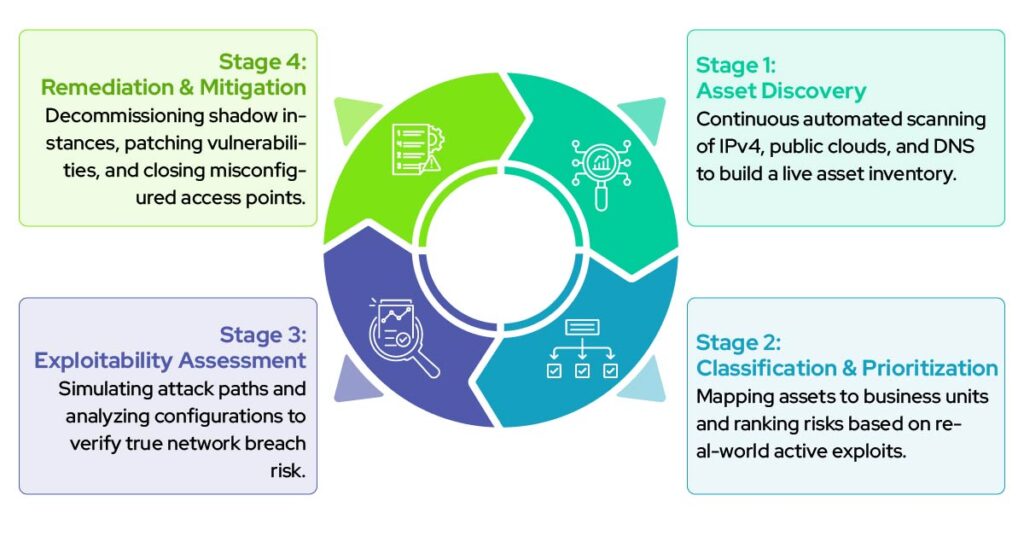
To execute this effectively at an enterprise scale, organizations must implement a structured, four-stage ASM Operational Lifecycle derived from industry best practices.
The Strategic Imperative: Why Traditional Vulnerability Scanning Falls Short
Traditional vulnerability management identifies security vulnerabilities within known assets but lacks the continuous visibility required for highly dynamic enterprise environments.
- Visibility Scope: Traditional vulnerability management focuses on known assets, while ASM continuously discovers unknown, unmanaged, and shadow assets across the attack surface.
- Security Perspective: Traditional assessments evaluate internal assets through scheduled scans. ASM adopts an attacker-centric perspective to identify publicly exposed assets and potential attack paths.
- Operational Frequency: Legacy assessment routines are periodic, leaving potential gaps between assessments. ASM provides continuous monitoring to detect new assets and emerging exposures in real time.
- Risk Coverage: Conventional vulnerability management primarily detects CVEs and misconfigurations. ASM extends visibility to exposed credentials, leaked secrets, unsecured APIs, cloud misconfigurations, and other external security risks.
By aligning with the industry-standard Continuous Threat Exposure Management (CTEM) framework, organizations can continuously identify, prioritize, and mitigate security exposures across their entire attack surface.
How StrongBox IT Mitigates Security Exposures
Unmanaged digital assets represent a severe operational risk. Organizations require a specialized partner to gain full visibility and achieve operational resilience.
StrongBox IT addresses these challenges through comprehensive External Attack Surface Management (EASM), defensive architecture validation, and specialized proactive risk management strategies:
- Shadow IT Elimination: Deploying advanced asset discovery tools to illuminate unmapped infrastructure, orphaned microservices, and unauthorized cloud deployments.
- Cloud Architecture & Configuration Security: Eliminating cloud posture vulnerabilities—such as publicly exposed S3 buckets, weak Identity and Access Management (IAM) entitlements, and misconfigured API keys.
- Continuous Vulnerability and Posture Assessment: Moving away from static, point-in-time assessments toward ongoing validation that responds to configuration changes in real time.
Maintaining an accurate inventory of public-facing assets is essential to corporate risk management. Partnering with StrongBox IT gives your organization the defensive visibility, engineering insight, and remediation strategies required to minimize your digital footprint and secure your infrastructure against modern cyber threats.