Latest Posts

Internal vs. External Threats: What Poses the Biggest Cyber Risk?
July 10, 2026
Cybersecurity threats can come from outside an organization or from within it. While many businesses focus on defending against hackers, malware, and cybercriminals operating externally, internal threats can be just as damaging. Employees, contractors, vendors, or trusted users with access to systems may intentionally or unintentionally expose sensitive data, disrupt operations, or create security gaps.
What are Cyber Threats?
Cyber threats are activities or events that can compromise the confidentiality, integrity, or availability of an organization's data, systems, or networks. These threats can originate from individuals inside the organization or from external actors seeking unauthorized access to valuable information.
The consequences of successful cyberattacks may include financial losses, operational disruption, reputational damage, regulatory penalties, and data breaches.
Understanding Internal Threats
Internal threats originate from individuals who already have authorized access to an organization's systems, networks, or data. These individuals may include employees, contractors, consultants, vendors, or business partners.
Internal threats are often difficult to detect because they involve trusted users operating within approved environments.
Types of Internal Threats
Malicious Insiders
Malicious insiders intentionally misuse their access to steal data, sabotage systems, commit fraud, or assist external attackers. Their actions may be motivated by financial gain, personal grievances, or competitive interests.
Examples include:
- Stealing customer databases
- Sharing confidential business information
- Deleting critical files
- Installing unauthorized software
Negligent Employees
Many insider incidents occur because of human error rather than malicious intent. Employees may unknowingly expose systems to cyber risks through unsafe practices.
Common examples include:
- Clicking phishing links
- Using weak passwords
- Sending sensitive data to the wrong recipient
- Misconfiguring security settings
- Falling victim to social engineering attacks
Compromised Accounts
An employee account can become an insider threat if attackers gain access through stolen credentials, phishing attacks, or malware infections.
Since compromised accounts often appear legitimate, attackers can move through systems without raising immediate suspicion.
Understanding External Threats
External threats originate from individuals or groups outside the organization. These actors seek unauthorized access to networks, applications, and sensitive information.
External attackers continuously look for vulnerabilities that can be exploited to gain access to systems or disrupt business operations.
Types of External Threats
External threats originate outside an organization and can impact security, operations, finances, and reputation.
Cybersecurity Threats
- Malware and Ransomware: Malicious software that disrupts systems or steals data.
- Phishing Attacks: Fraudulent messages designed to obtain sensitive information.
- DDoS Attacks: Attempts to overload systems and make services unavailable.
- Data Breaches: Unauthorized access to confidential information.
Environmental and Physical Threats
- Natural Disasters: Floods, earthquakes, and other events that disrupt operations.
- Theft and Vandalism: Loss or damage to physical assets and information.
- Health Emergencies: Events that affect workforce availability and business continuity.
Economic Threats
- Market Competition: Competitors are gaining an advantage through pricing or innovation.
- Economic Downturns: Inflation, recessions, or changing market conditions.
- Supply Chain Disruptions: Delays or shortages involving suppliers and logistics partners.
Regulatory and Political Threats
- Regulatory Changes: New laws and compliance requirements.
Internal Threats vs. External Threats
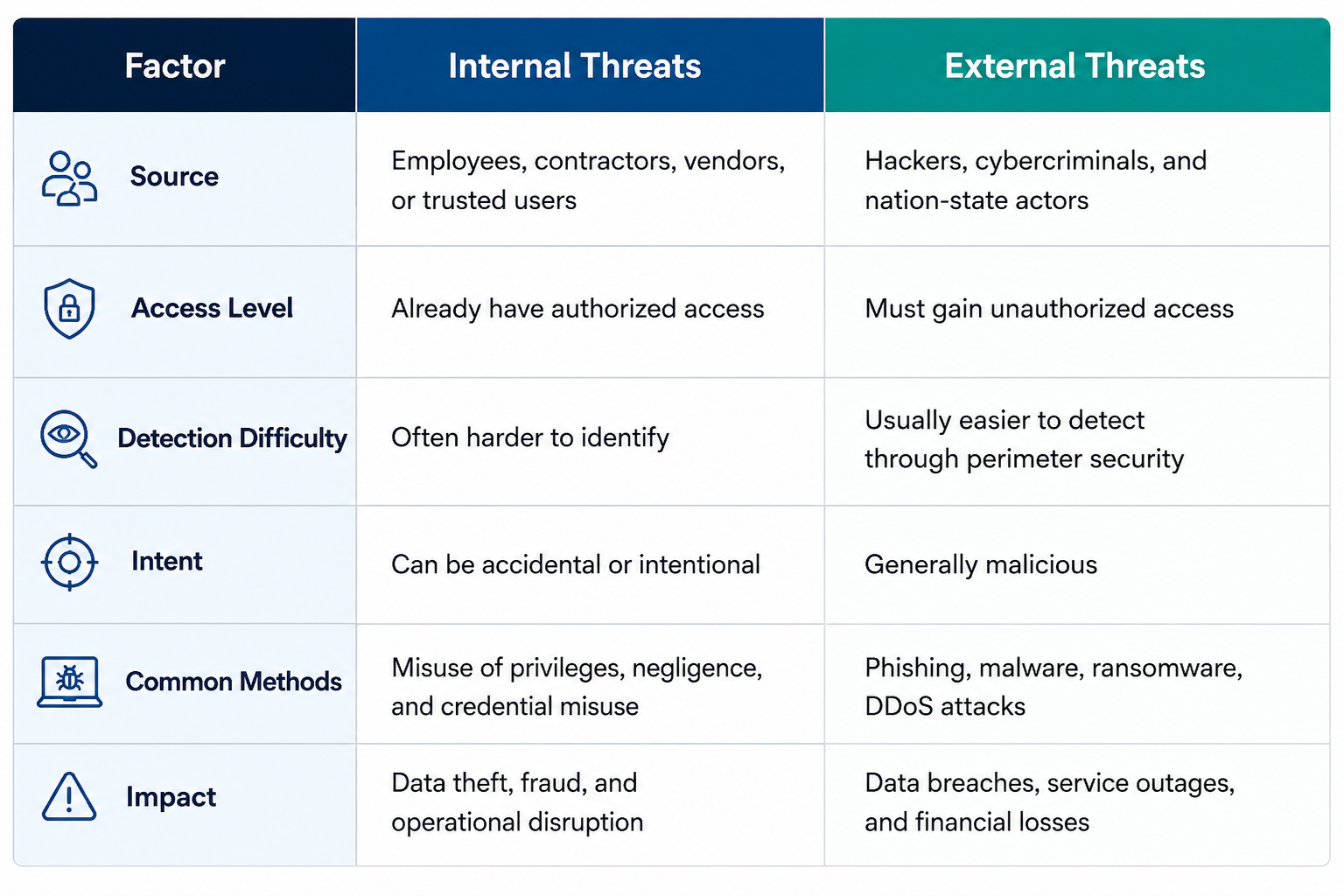
Which Threat Poses the Bigger Risk?
There is no single answer because both internal and external threats present significant risks.
External threats are more visible and often receive greater attention because they involve direct attacks from cybercriminals. However, internal threats can be especially dangerous because insiders already have access to critical systems and sensitive information.
Organizations frequently invest in firewalls, intrusion detection systems, and endpoint protection to defend against external attackers. Yet a single employee mistake or insider misuse of privileges can bypass many of these defenses.
The biggest cyber risk often arises when internal weaknesses enable external attacks. For example, an employee falling for a phishing email may provide attackers with the credentials needed to infiltrate the organization's network.
Rather than viewing one threat as more dangerous than the other, businesses should recognize that both require equal attention and proactive risk management.
How to Reduce Internal Threat Risks
Organizations can lower insider risks by combining access controls, employee awareness, and continuous monitoring. A proactive approach helps prevent both intentional misuse and accidental security incidents.
Limit access to essential resources
Grant employees access only to the systems and data required for their roles. Regularly review user permissions to ensure access remains appropriate.
Track user behavior and system activity to identify unusual actions, such as unauthorized data access, large file transfers, or access attempts outside normal working hours.
Implement data protection controls
Use security solutions that prevent sensitive information from being shared, copied, or transferred through unauthorized channels.
Provide security awareness training
Conduct regular training sessions to help employees recognize phishing attempts, social engineering tactics, and safe data-handling practices.
Strengthen employee offboarding procedures
Immediately remove access to company systems when employees leave the organization and ensure all company devices and credentials are properly secured or returned.
How to Reduce External Threat Risks
Organizations can minimize external threats by adopting multiple layers of security and proactively addressing vulnerabilities.
Regularly apply security patches and software updates to reduce the risk of exploitation.
Use firewalls, intrusion detection systems (IDS), and endpoint protection tools to block unauthorized access and malicious activity.
Implement strong access controls
Follow the principle of least privilege and require multi-factor authentication (MFA) to protect user accounts from unauthorized access.
Encrypt critical data and maintain regular backups to ensure business continuity in the event of an attack.
Monitor and assess risks continuously
Conduct regular vulnerability assessments and monitor systems for suspicious activity to identify threats early.
Evaluate the security practices of vendors and partners who have access to organizational systems or data.
Educate employees on phishing, social engineering, and other common attack methods to reduce human-related security risks.
Why a comprehensive security approach matters
Cyber threats can target people, systems, and processes simultaneously. A comprehensive security approach helps organizations address these risks through multiple layers of protection, reducing vulnerabilities and improving overall resilience.
Key benefits include:
- Better Risk Management: Identifies and addresses security gaps.
- Stronger Protection: Combines technology, policies, and employee awareness.
- Reduced Attack Surface: Limits opportunities for attackers.
- Regulatory Compliance: Supports compliance with security requirements.
- Business Continuity: Helps organizations respond to and recover from incidents.
- Customer Trust: Protects sensitive data and strengthens confidence.
By combining security controls, continuous monitoring, and employee training, organizations can better defend against both internal and external threats.
Conclusion
Internal and external threats represent two sides of the cybersecurity challenge facing modern organizations. External attackers continuously search for vulnerabilities, while insider threats can emerge through malicious actions, compromised accounts, or simple human mistakes. Both can result in data breaches, financial losses, and operational disruptions.
A balanced security strategy that combines employee awareness, access controls, continuous monitoring, and proactive threat management is essential for reducing risk. At StrongBox IT, we help organizations identify security gaps, assess vulnerabilities, and strengthen defenses against both internal and external cyber threats, helping businesses build a more resilient security posture.