Latest Posts

Is AI in Cybersecurity a Friend or Foe for Modern Organizations
July 3, 2026
Artificial Intelligence (AI) is significantly transforming the cybersecurity environment, changing how organisations detect, prevent, and respond to cyber threats. While AI offers advanced capabilities that strengthen security systems, it also introduces new risks when used by malicious actors.
In this article, the dual role of AI in cybersecurity is explained, highlighting whether it acts as a powerful ally or a potential threat for modern organisations.
Understanding the role of AI in cybersecurity
AI in cybersecurity involves the use of machine learning and intelligent systems to strengthen digital security. These technologies help organisations monitor systems and protect sensitive data more effectively.
It works by analysing large volumes of data and identifying unusual patterns or behaviours that may indicate potential threats. This allows faster detection compared to traditional security methods.
AI also supports real-time response, enabling systems to react quickly to suspicious activities and reduce potential damage. This improves the overall efficiency of security operations.
Another key advantage is its ability to recognise patterns that may not be easily detected by humans, helping organisations stay ahead of emerging cyber risks.
However, these same capabilities can also be misused by cybercriminals to create advanced attacks, making AI both a powerful defence tool and a potential threat.
AI as a friend: strengthening cybersecurity
AI plays a strong supporting role in cybersecurity by improving how organisations detect, analyse, and respond to threats. It enhances security operations by automating routine processes and identifying unusual activities, allowing faster response times and reducing the chances of attacks going unnoticed.
AI systems continuously analyse network traffic, user behaviour, and large volumes of data to identify suspicious patterns. This helps detect potential threats at an early stage, often before any significant damage occurs.
AI-driven tools can take immediate action when a threat is detected, such as blocking malicious access or isolating affected systems. This reduces the workload on security teams and limits the impact of security incidents.
AI improves accuracy by distinguishing between genuine threats and harmless irregular activities. This allows security teams to focus on real risks instead of spending time on unnecessary alerts.
By learning from previous attack patterns, AI can anticipate possible vulnerabilities and threats. This enables organisations to strengthen their security measures in advance and reduce exposure to risks.
Enhanced identity and access management
AI continuously monitors user behaviour and access patterns. It can adjust permissions when unusual activity is detected, helping prevent unauthorised access and identity-based attacks.
While AI strengthens cybersecurity in many ways, it is important to recognise that it can also be misused. This dual nature makes it essential for organisations to implement AI carefully, ensuring it supports defence without introducing new risks.
AI as a foe: emerging cybersecurity risks
While AI strengthens security, it also creates new risks when used by attackers. Cybercriminals are using AI to make attacks faster, more targeted, and harder to detect.
AI enables highly personalised phishing messages that can bypass filters and trick users into sharing sensitive information.
Voice and video manipulation is used to impersonate trusted individuals, leading to financial fraud and reputational damage.
AI helps create malware that can change its form to avoid detection and exploit vulnerabilities quickly.
Attackers can interfere with AI systems by altering training data, causing incorrect threat detection.
Uncontrolled use of AI tools within organisations can lead to accidental data leaks and security gaps.
To manage these risks, businesses should combine AI-driven security tools with strong policies, employee awareness, and proper access controls.
The ethical and governance challenges
The use of AI in cybersecurity raises concerns around data privacy, bias, and accountability, especially as organisations rely more on automated systems for decision-making.
- Data privacy risks due to large-scale data processing
- Bias in AI models affecting accuracy and fairness
- Limited accountability in automated actions
There is also a lack of clear and consistent global regulations for AI, making it difficult for organisations to manage risks effectively across different regions.
- Absence of uniform standards for AI governance
- Challenges in meeting multiple regulatory requirements
- Risk of over-reliance on AI without human oversight
Friend or foe: The real answer
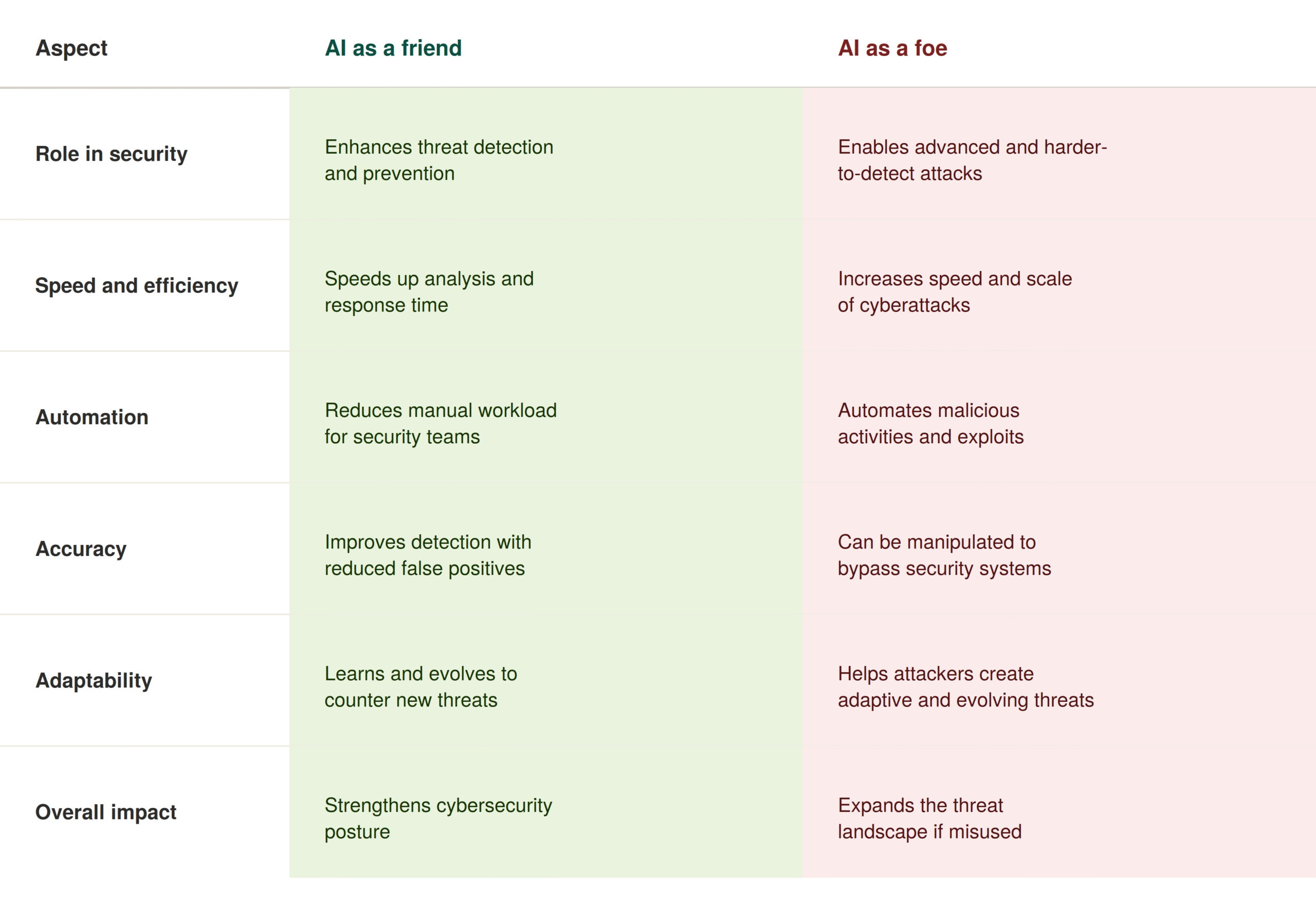
AI in cybersecurity cannot be viewed as entirely beneficial or harmful, as its impact depends on how it is used and managed within an organisation.
How Strongbox IT helps businesses leverage AI securely
Adopting AI in cybersecurity requires the right strategy, expertise, and continuous monitoring. This is where Strongbox IT supports organisations in balancing innovation with security.
Strongbox IT helps businesses:
- Identify risks associated with AI adoption
- Secure AI-driven systems and applications
- Detect vulnerabilities through advanced testing
- Implement proactive threat monitoring
- Ensure compliance with evolving cybersecurity standards
By combining AI capabilities with strong security practices, Strongbox IT enables organisations to use AI as an advantage rather than a risk.
Best practices for using AI in cybersecurity
To maximise the benefits of AI while minimising risks, organisations should:
- Combine AI tools with human expertise
- Regularly monitor and update AI systems
- Implement strict access and data security controls
- Ensure transparency and accountability in AI usage
- Conduct continuous security assessments
Conclusion
AI is transforming cybersecurity by offering powerful tools to detect and prevent threats. At the same time, it introduces new challenges when misused by attackers.
Rather than viewing AI as purely beneficial or harmful, organisations should recognise its dual role and adopt a balanced approach. With proper implementation and support from experts like Strongbox IT, businesses can harness AI effectively while maintaining strong cybersecurity protection.