Latest Posts
Why Manufacturing Industries Are Facing More Cyberattacks in 2026
September 1, 2026
For multiple consecutive years, manufacturing has held the title of the most heavily targeted industrial sector globally. The sector accounts for over two-thirds of all industrial ransomware incidents, outpacing healthcare, energy, and financial services.
This target on manufacturing is not accidental. The sector’s rapid digital transformation—driven by Industry 4.0, IIoT integration, and cloud-connected industrial control systems (ICS)—has outpaced the evolution of its defensive security architectures.
To mitigate these threats, CISOs and OT security teams must look beyond generic corporate IT controls and understand the structural, architectural, and operational vectors making industrial environments vulnerable in 2026.
1. The Compromise of Network Segmentation: Merged IT/OT Architectures
Historically, industrial systems were kept completely disconnected from corporate office networks. Today, remote access and digital tools have removed that barrier.
- The Core Risk: Nearly half of evaluated manufacturing environments now share domain controllers or directory services between IT and OT.
- The Impact: Attackers no longer need complex industrial protocol exploits to reach shop-floor control systems. A single compromised corporate credential grants direct lateral access into the production environment.
2. Strategic Hypervisor and Infrastructure Targeting
A significant shift in 2026 adversary tactics is the direct targeting of the virtualization layer hosting critical operational software.
Cybercriminals rarely start by hacking complex factory controllers. Instead, they use stolen passwords or remote login tools to take over the central servers and virtual systems that manage essential operational software, centralized monitoring tools, and plant operations.
- Supervisory Control and Data Acquisition (SCADA) servers
- Human-Machine Interfaces (HMIs)
- Process Historians
- Engineering Workstations (EWS)
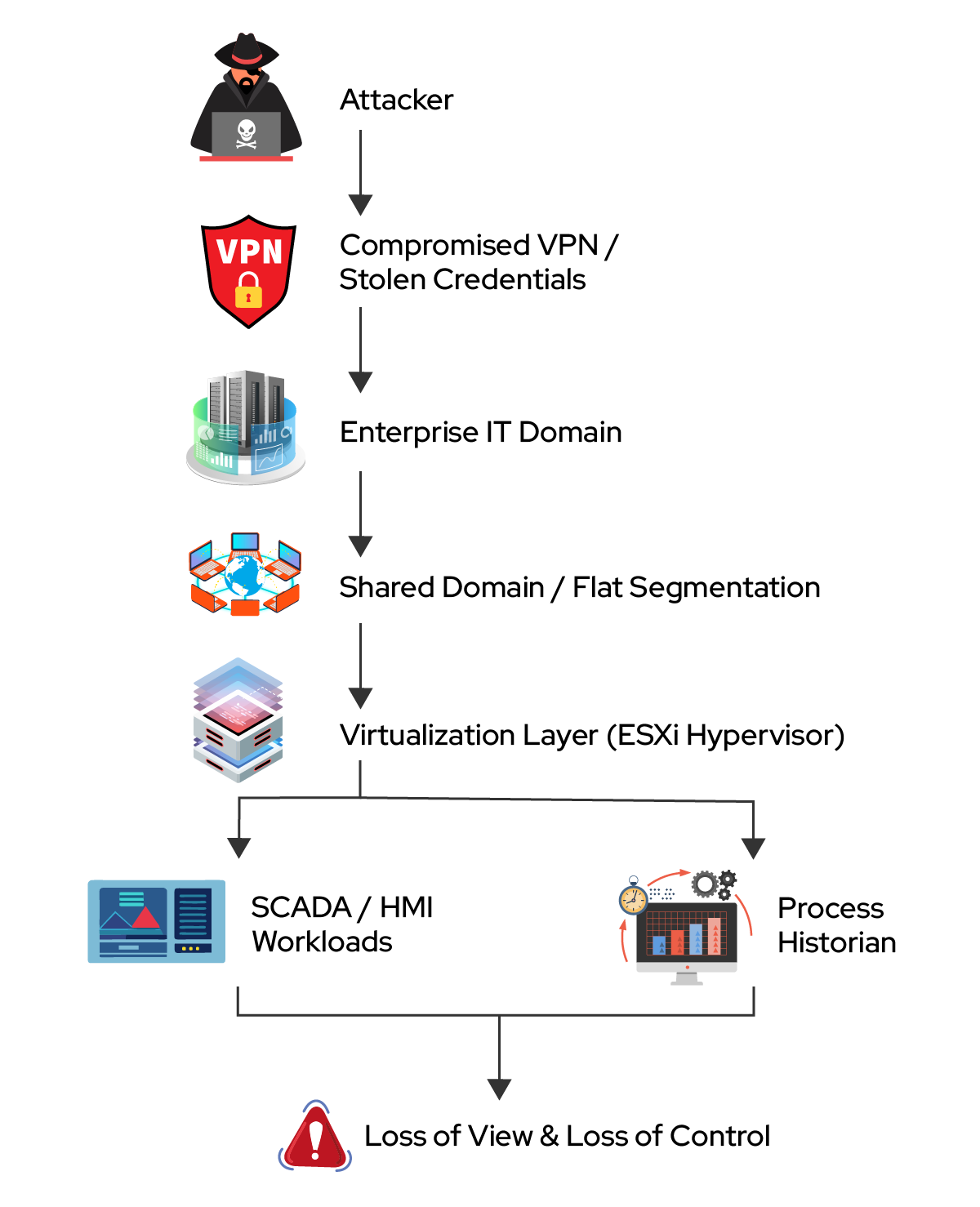
- Attacker
- Compromised VPN / Stolen Credentials
- Enterprise IT Domain
- Shared Domain / Flat Segmentation
- Virtualization Layer (ESXi Hypervisor)
- SCADA / HMI Workloads - Process Historian
- Loss of View & Loss of Control
By encrypting or taking down the hypervisor layer, threat actors cause immediate Loss of View (LoV) and Loss of Control (LoC) for plant operators. Production comes to a complete standstill without the adversary ever crafting a single low-level ICS payload.
3. Persistent Reconnaissance: Stage 2 Threat Groups Exfiltrating OT Intelligence
While ransomware causes immediate financial disruption, sophisticated nation-state and Stage 2 threat groups (such as AZURITE) operate under the radar.
Rather than deploying destructive wiper malware, these groups specifically target Engineering Workstations to exfiltrate:
- Process configuration files and ladder logic diagrams
- Industrial alarm thresholds and telemetry data
- Operator credentials and network topology maps
Attackers collect this information to understand how your operations work. This lets them prepare attacks in advance, ready to trigger during major political crises or business conflicts.
4. The Visibility Gap: Limited ICS Monitoring and Native Tool Exploitation
A major challenge in industrial security is limited visibility. Cyberattacks are often noticed only when machinery behaves strangely, rather than through automated alerts. Attackers can also use built-in system management tools—like PowerShell, remote desktop access, and Windows administrative scripts—to move silently through management networks.
- Monitoring Gaps: Standard security software often cannot understand specialized industrial communication languages, while older control systems frequently cannot run modern security monitoring tools.
- Logging Gaps: Without centralized record-keeping, tracking administrative activity, pinpointing how attackers entered, or investigating unauthorized system changes becomes nearly impossible.
5. Uncontrolled Third-Party Vendor Access
Factories often rely on external vendors, contractors, and machinery suppliers for remote maintenance. However, granting broad remote access creates major vulnerabilities.
- Over-Privileged VPNs: Traditional VPNs often give outside vendors access to the entire network, rather than restricting them to the specific machine or system they need to service.
- Unmonitored Remote Access: Without strict session monitoring, time limits, or activity recording on connection servers, stolen credentials and unauthorized actions can easily go unnoticed.
Building a Defensible OT Security Posture
A resilient industrial security architecture should combine network segmentation, Zero Trust Network Access (ZTNA), least-privilege access, and OT-aware monitoring.
Essential Defensive Controls for Industrial Operations
- Segment IT and OT Networks: Use OT-aware firewalls and controlled access gateways to isolate critical industrial zones.
- Restrict Remote Vendor Access: Replace broad VPN access with MFA-protected, session-based access limited to required systems and services.
- Deploy OT-Native Monitoring: Use passive asset discovery and industrial protocol monitoring to detect unauthorized changes and anomalous commands.
- Align with Security Standards: Map OT security controls to frameworks such as IEC 62443, NIST CSF 2.0, and applicable NIS2 requirements.
How StrongBox IT Strengthens Your Industrial Cyber Resilience
Transitioning an active, high-uptime manufacturing facility toward a Zero Trust posture requires specialized expertise that balances rigorous security with operational continuity.
At StrongBox IT, we help manufacturing organizations strengthen converged IT/OT environments without disrupting critical operations.
- OT/ICS Security Assessments: Identify vulnerabilities, legacy asset risks, and IT/OT architecture weaknesses.
- Industrial Penetration Testing: Simulate real-world attacks against OT networks, remote access, and critical systems.
- Zero Trust & Segmentation: Enforce least-privilege access and micro-segmentation to isolate critical operations and restrict unauthorized movement..
- OT Incident Response: Prepare teams to detect, contain, investigate, and recover from industrial cyber incidents.
Conclusion
As IT and OT environments become increasingly connected, manufacturing organizations face greater exposure to cyber threats that can disrupt production and critical operations. Strengthening segmentation, remote access, monitoring, and incident response helps reduce attack paths while maintaining operational continuity.
Secure Your OT Environment with StrongBox IT
Identify vulnerabilities across your industrial environment before attackers exploit them. Partner with StrongBox IT for specialized OT/ICS security assessments and penetration testing.