Latest Posts

Medical Device Penetration Testing - FDA Requirements, Standards, and Best Practices
November 12, 2026
Medical devices increasingly rely on connected technologies to support healthcare services. Smart infusion pumps, patient monitoring systems, diagnostic equipment, and software-based medical applications use digital components to process information, communicate with other systems, and support clinical decisions.
However, connectivity can introduce cybersecurity risks. Vulnerabilities may expose sensitive patient information, disrupt device operations, or affect the availability of healthcare services. In certain situations, compromised device functionality may also create patient safety concerns.
Medical device penetration testing helps manufacturers identify and assess security vulnerabilities in devices and their connected systems. Understanding applicable FDA requirements, recognised standards, and testing practices helps manufacturers strengthen device security and support regulatory documentation.
Understanding FDA Cybersecurity Requirements for Medical Devices
The U.S. Food and Drug Administration (FDA) addresses cybersecurity as part of medical device safety and performance. Its guidance provides recommendations for incorporating security into device design, preparing premarket submissions, and managing cybersecurity risks throughout a device's lifecycle.
Section 524B of the Federal Food, Drug, and Cosmetic Act (FD&C Act), which took effect on March 29, 2023, establishes specific cybersecurity requirements for qualifying cyber devices and relevant premarket submissions. The FDA's February 2026 guidance provides recommendations for cybersecurity design, labelling, and premarket documentation.
Key FDA Cybersecurity Expectations
Manufacturers should assess cybersecurity risks during development and evaluate whether security controls address identified threats. Penetration testing can help determine whether vulnerabilities in device software, interfaces, or connected systems could be exploited.
Testing results can support risk assessments and relevant regulatory documentation. However, penetration testing should form part of a broader cybersecurity programme rather than be treated as the only security assessment required.
Cybersecurity responsibilities continue after a device enters the market. Manufacturers need processes to identify reported vulnerabilities, assess their potential impact, and provide appropriate security updates and patches.
For cyber devices covered by Section 524B, manufacturers must submit a plan for monitoring, identifying, and addressing postmarket vulnerabilities and exploits. This includes coordinated vulnerability disclosure procedures.
An SBOM is an inventory of software components included in a device, including commercial, open-source, and off-the-shelf components.
Maintaining an SBOM helps manufacturers determine whether newly reported vulnerabilities affect components used in their products. This information supports vulnerability assessment, remediation planning, and ongoing risk management.
Manufacturers should maintain documentation showing how cybersecurity risks were identified, assessed, and addressed. Relevant records may include threat assessments, security controls, penetration testing results, and decisions about remaining risks.
These assessments should consider both cybersecurity consequences and potential effects on device safety and performance.
Section 524B applies to qualifying cyber devices and relevant submissions. Manufacturers should determine their specific obligations based on the device and applicable regulatory requirements rather than assume that every provision applies to every medical device.
What Does Medical Device Penetration Testing Cover?
Medical device penetration testing examines whether attackers could exploit vulnerabilities in a device or its connected systems. Unlike an assessment limited to a website or corporate network, medical device testing may involve hardware, firmware, communication interfaces, applications, and healthcare infrastructure.
Testing must be planned carefully to avoid disrupting device operation or creating risks to patient safety. The scope should reflect the device's intended use, technical design, connectivity, and potential clinical impact.
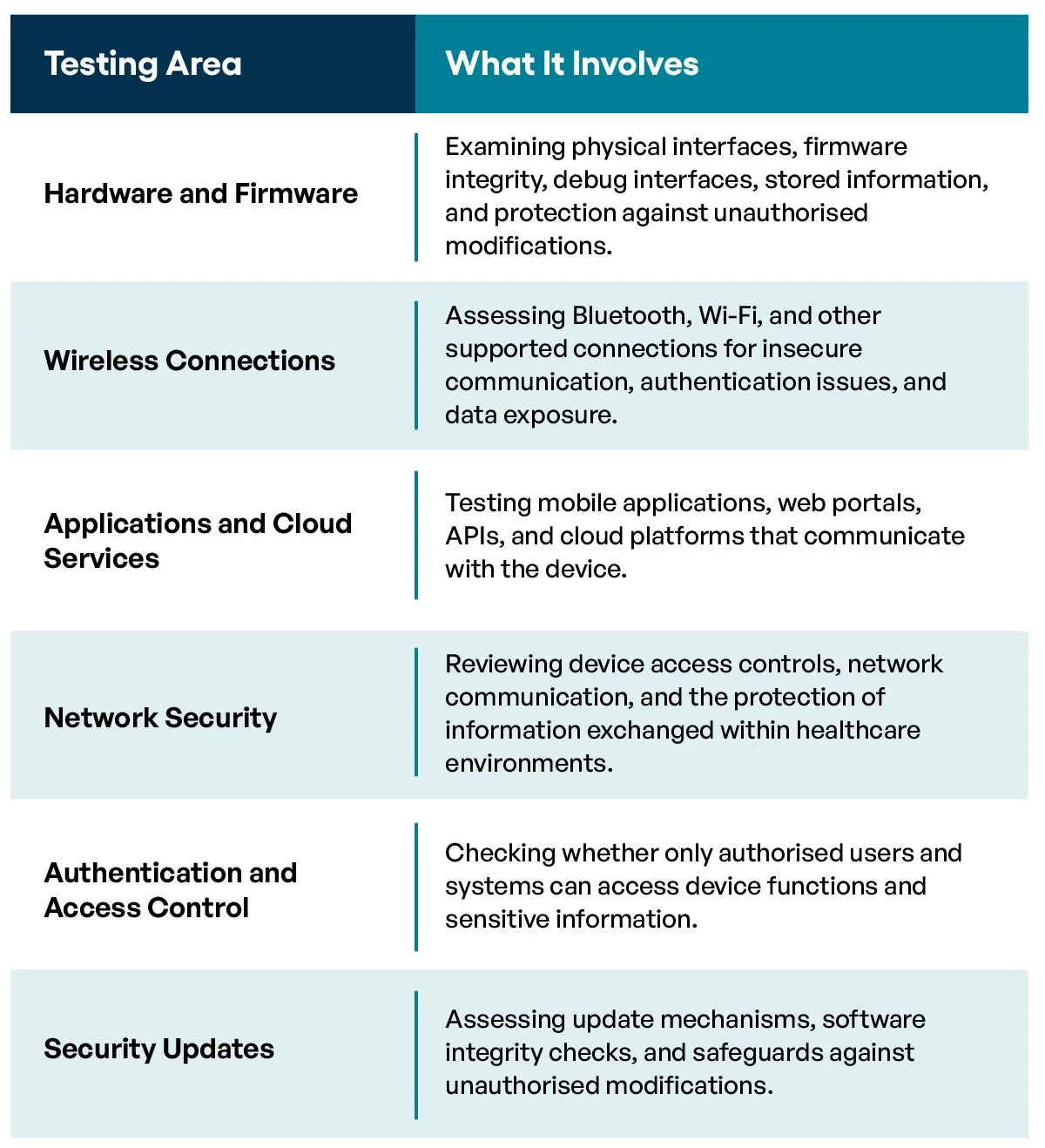
The final scope depends on the device architecture, operating environment, applicable regulatory requirements, and agreed testing objectives.
Relevant Standards and Frameworks for Medical Device Cybersecurity
Medical device manufacturers use recognised standards and frameworks to guide cybersecurity risk management, software development, and testing. Their applicability depends on the device, intended use, and regulatory requirements.
1. ISO 14971: Medical Device Risk Management
ISO 14971 guides risk identification, evaluation, control, and monitoring throughout a medical device's lifecycle. It helps manufacturers assess how cybersecurity issues could affect device safety and performance.
2. IEC 81001-5-1: Health Software Cybersecurity
IEC 81001-5-1 addresses cybersecurity throughout the health software lifecycle, including security requirements, implementation, verification, and maintenance.
3. IEC 62304: Medical Device Software Lifecycle
IEC 62304 defines lifecycle processes for medical device software development and maintenance. It supports structured software engineering but is not a standalone penetration testing standard.
4. IEC 62443: Industrial Automation and Control System Security
The IEC 62443 series addresses industrial control system cybersecurity. Relevant parts may apply to medical devices or supporting infrastructure connected to these environments.
5. FDA Cybersecurity Guidance
The FDA provides recommendations for device security and premarket submissions. Manufacturers must distinguish these recommendations from applicable statutory requirements under Section 524B.
These standards and frameworks serve different purposes. Selecting appropriate references helps manufacturers align security testing with device risks and regulatory obligations.
Best Practices for Medical Device Penetration Testing
Medical device security should be addressed throughout product development and maintenance rather than only before a regulatory submission. The following practices help manufacturers organise testing and manage cybersecurity risks.
 Include Security Early in Development
Security testing is more useful when it begins during the design stage. Manufacturers should identify potential attack paths, review how the device handles sensitive information, and establish appropriate security controls before development is complete.Early assessments can help teams address design issues before they become more difficult or costly to correct.
-
Test the Final Device Configuration
Testing should reflect the configuration intended for release or regulatory submission. This includes the relevant software, firmware, applications, interfaces, and security settings.If a subsequent change affects security, manufacturers should assess its impact and determine whether additional testing is necessary. This helps maintain the relevance of previous findings and test results.
-
Consider Patient Safety Alongside Cybersecurity
A vulnerability's significance depends on more than its technical severity. Manufacturers should consider how exploitation could affect patient care, device operation, or access to clinical services.For example, an issue affecting an infusion pump's settings or a patient monitor's alarms may have different consequences from a vulnerability that exposes information without directly affecting device functionality.Security assessments should therefore consider both technical risk and potential clinical consequences. Testing procedures must also account for device-specific safety requirements.
-
Combine Automated Tools With Expert Testing
Automated tools can help identify known vulnerabilities, outdated components, and common security configuration issues. They can also support repeatable checks across multiple versions and configurations.However, automated tools may not fully assess how vulnerabilities can be combined, whether access controls can be bypassed through a sequence of actions, or how a device responds to unusual conditions.Expert-led penetration testing provides a deeper examination of identified issues, communication behaviour, access controls, and possible attack paths. Combining both approaches helps manufacturers develop a more complete understanding of device security.
-
Maintain Security After Deployment
Cybersecurity risks can change after a device is released. New vulnerabilities may affect software components, communication libraries, operating systems, or connected services.Manufacturers should maintain processes for monitoring security information, evaluating reported issues, providing appropriate updates, and communicating with relevant stakeholders.These activities support ongoing risk management throughout the device lifecycle and help manufacturers respond to changes in the threat environment.
How StrongBox IT Helps Secure Medical Devices
Medical device manufacturers need to understand how vulnerabilities could affect connected systems, sensitive information, and device operation. At StrongBox IT, we provide Vulnerability Assessment and Penetration Testing (VAPT) services to help organisations assess security risks across applications, infrastructure, and connected technologies.
Our testing approach can include reviewing device interfaces, examining firmware security, assessing wireless communication, and evaluating APIs and cloud services within the agreed scope. Combining automated security checks with manual penetration testing helps investigate potential vulnerabilities, validate findings, and assess possible attack paths.
These assessments can support manufacturers' broader cybersecurity risk management activities and provide findings for consideration alongside applicable standards and regulatory requirements. Tailor testing scope, procedures, and documentation to the device's intended use, technical architecture, and safety considerations.
Conclusion
Medical device penetration testing helps manufacturers identify and assess cybersecurity vulnerabilities that could affect sensitive information, device operation, and patient safety. Understanding applicable FDA requirements, relevant standards, and established testing practices supports a structured approach to security assessment and risk management.
However, cybersecurity is not a one-time activity. Manufacturers should integrate security into development, assess the impact of product changes, and maintain processes for addressing vulnerabilities after deployment. By combining manual penetration testing, automated security checks, appropriate risk management practices, and ongoing monitoring, organisations can improve their understanding of cybersecurity risks and strengthen protection for medical devices and their supporting systems.